
Horses perceive their environment in a very different way from humans. While humans rely heavily on vision, the sensory system of the horse, due to its nature, is far more focused on movement, danger detection, and social communication.
The following is a comprehensive look at the horse’s seven senses: sight, hearing, touch, taste, smell, balance, and proprioception.
1. Vision – movement before detail
The horse’s eye is one of the largest among land mammals and is positioned on the sides of the head. This creates an extremely wide field of vision, giving horses almost panoramic sight.
Panoramic vision and blind spots
Horses have a very wide field of vision to both sides, but they also have several blind spots. These are located directly in front of the forehead at close range, beneath the neck and belly, above their back and directly behind the tail.
For this reason, horses must actively move their head and sometimes even their body to fully perceive these areas.
Unlike humans, the visual information from both eyes is not always seamlessly integrated. Horses often need to look at an object with both eyes to clearly identify and understand it.
2D and 3D vision
Horses mainly see in two dimensions through their lateral vision. True three-dimensional and spatial vision only occurs in the frontal field where both eyes work together.
To perceive an object clearly and in depth, the horse usually needs to actively focus on it. Without fixation, perception remains flatter and more movement-oriented.
Switching between these two visual systems can sometimes cause brief uncertainty when an object suddenly appears different from another angle.
Motion detection
Horses are extremely sensitive to movement. Even tiny movements in the peripheral field are detected quickly. This is an important survival mechanism for detecting danger.
Color vision
A horse’s color vision differs significantly from that of humans. Horses are dichromatic, meaning they only possess two functional cone types in the retina, whereas humans have three.
Horses distinguish blue and yellow tones particularly well. Red tones, however, are not perceived as true red but rather as grayish, brownish, or dark shades.
Their visual world is therefore less colorful than ours, although not colorless. Contrast, brightness differences, and movement also remain really important for orientation.
Night vision and light adaptation
Horses have excellent night and twilight vision and can see far better than humans in low-light conditions.
However, they require more time to adapt to changing light conditions. Moving from bright sunlight into a dark stable, for example, can briefly create insecurity until the eyes adjust fully.
Importance in handling and training
For everyday handling and training, this means:
- Clear contrasts and horse-friendly colors improve orientation
- The neck should remain freely movable so the horse can properly observe its environment
- Horses should be given enough time to adapt to changing light conditions
Many spooking reactions or hesitation are not acts of disobedience but are caused by visual factors such as movement, perspective changes, or insufficient light adaptation.
Likewise, forced head and neck positions or restrictive training aids can negatively affect both vision and balance.
2. Hearing – the 180° radar system
The horse’s ear is a highly developed localization system. Horses can rotate their ears almost 180° independently from one another, allowing them to precisely locate sounds.
Their hearing range is extremely broad and particularly sensitive between approximately 55 Hz and 33,000 Hz, far exceeding human hearing.
Wind can significantly distort sound perception, making it difficult for horses to identify the exact direction of a sound. This is especially noticeable in forests or dense environments where sound reflects and echoes. Many horses therefore feel safer in open landscapes or elevated areas with a wide view.
3. Touch – an extremely sensitive sense
The sense of touch in the horse is highly refined and essential for environmental perception and orientation.
The skin reacts very sensitively to pressure, touch, and tiny stimuli, especially around the head, flanks, and abdomen. Even small stimuli can trigger rapid defensive reactions such as skin twitching to repel insects. This reaction is controlled by the erector pili muscle, the smallest muscle in the horse’s body, which also regulates hair raising during weather changes.
The hooves also serve as important sensory organs, allowing horses to perceive vibrations, terrain structure, and stability.
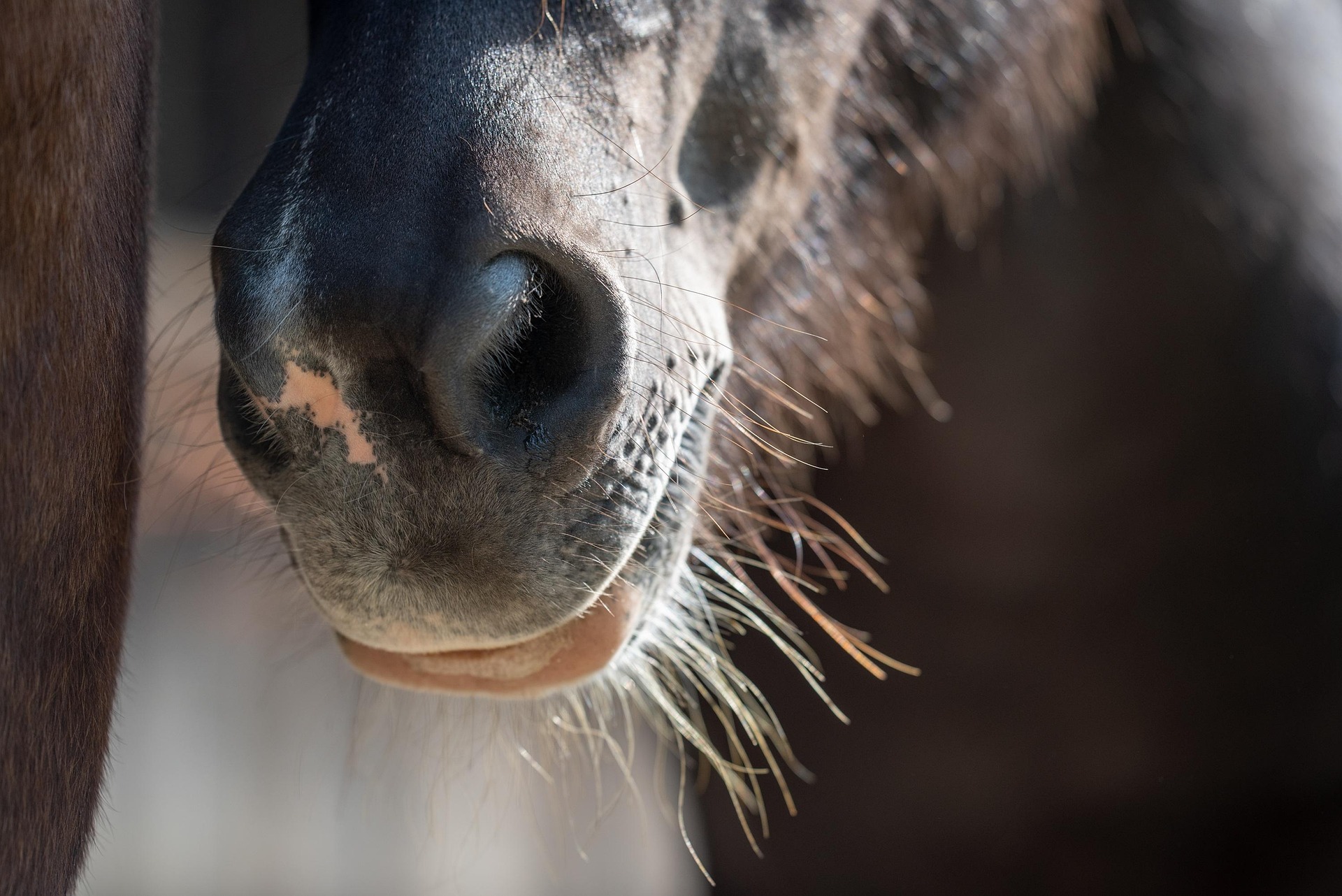
The tactile whiskers around the muzzle and eyes are extremely sensitive and help with close-range orientation, food selection, and protection of sensitive facial areas. For animal welfare reasons, they should never be removed.
4. Taste – selective and highly individual
The sense of taste in the horse is closely linked to smell. Horses can distinguish sweet, salty, sour, and bitter tastes.
They generally prefer sweet flavors, while bitter tastes are often avoided because they may indicate potentially harmful plants.
However, this is not absolute. Individual preferences mean that some horses may still consume toxic plants or spoiled feed. Even thorny plants may be willingly eaten by certain horses.
Horses also perceive the taste of water very precisely. Changes in taste or quality may reduce water intake significantly. Therefore, suitable neutral materials for water containers and protection from direct sunlight are important.
5. Smell – the emotional and social sense
The sense of smell in the horse is highly developed and plays a major role in communication and environmental awareness.
Horses identify other horses, emotional states, food quality, water sources, and potential dangers through scent.
An important behavior is the so-called “reading the newspaper,” where horses gather information through the smell of urine and manure from other horses. These scent signals provide information about health, sex, hormones, and activity.
The mare-foal bond is also strongly based on scent recognition immediately after birth.
Horses additionally “scan” humans through smell. Strong perfumes or artificial scents may interfere with or distort this natural perception.
6. Balance – the natural balancing pole
The balance system of the horse is located in the inner ear and works closely with body awareness.
The neck acts as a natural balancing pole and plays a key role in maintaining coordination and stability.
For this reason, the neck should not constantly be forced into unnatural positions or restricted through training aids. Riders should also work on their own seat and balance to avoid disturbing the horse’s natural movement.
7. Proprioception – body awareness and sure-footedness
The horse’s deep perception, also called proprioception, describes the ability to perceive the body’s position in space and understand where individual body parts are located relative to one another.
This perception is closely connected to balance and forms the basis for coordination, stability, and safe movement.
Horses constantly assess whether the ground is stable, slippery, uneven, or soft. The hooves play a central role by continuously providing information about vibrations and terrain conditions.
Training on varied and slightly unstable surfaces is therefore important to build confidence and sure-footedness. Hesitation on difficult terrain should not be interpreted as disobedience but as a natural survival instinct and safety assessment. Horses do not blindly walk across every surface; they actively evaluate the safety of the ground before moving forward.
Conclusion
The sensory world of the horse is a finely coordinated system of perception, movement, and instinct. None of the senses work independently; all systems interact and allow fast, precise responses to the environment.
Understanding this sensory world helps avoid misunderstandings and problems while promoting more horse-friendly handling and training practices.
Author: Lynn Kirsch www.soleiftri.com
Deja un comentario